How to Breathe While Running: The Best Breathwork for Runners
For many runners, breathing can be an after-thought. You plan your route, your pace, your footwear, and your recovery – but leave the several thousand breaths in between to sort themselves out. For most people that works right up until the effort increases – and then breathing becomes the first thing to unravel – turning shallow and ragged usually before your legs give out.
Knowing how to breathe while running is important because when you run, your muscles need far more oxygen to produce energy, and the carbon dioxide that builds up has to be cleared just as fast. When your breathing starts to suffer, it’s usually a sign that this demand has outpaced something – either your cardiovascular fitness or your breathing efficiency; luckily breathing, like fitness, is trainable.
Why Breathing Technique Matters for Runners
Breathing is easy to overlook when you train – and very easy to underestimate. But here’s more on why it matters. The way you breathe has a direct influence over how you prepare for a run, your performance during a run, and how quickly you recover afterwards. The diaphragm itself fatigues during hard, sustained running, drawing blood away from the working muscles and tiring your legs faster. By breathing correctly, your whole system holds together for longer.
How Should You Breathe While Running?
The quickest way to improve your breathing while running is to breathe deep and slow rather than fast and shallow, and use your nose as much as your pace allows – breathing through your mouth only when nasal breathing starts to feel like a struggle.
Most runners breathe the way most people breathe – quick, shallow, and high in the chest. Each of those breaths moves relatively little air, which forces you to breathe faster to compensate, and that pattern tires you out faster, and leaves you breathless. Slowing down and breathing into your belly (through your nose) is what reverses this as it results in more air per breath, fewer breaths, and better oxygen delivery.
The Best Breathing Techniques for Runners
There isn’t one right way to breathe while running – most good runners use a variety of techniques. Here are the ones worth learning:
1. Diaphragmatic (Belly) Breathing
Rather than lifting the chest and shoulders, you should draw air down by contracting the diaphragm and letting the belly expand, so the lungs fill more completely. The result is more air moved per breath, which means you don’t have to breathe as often to take in the same amount of oxygen.
Try practising this before a run. Lie on your back, rest a hand on your stomach, and breathe so it rises on the inhale and falls on the exhale while your chest stays relatively still. Once that feels natural lying down, try it on a walk, then an easy jog, and once it’s a habit, try it on a run.
2. Rhythmic Breathing
Rhythmic breathing ties your breath to your stride, usually in a 3:2 pattern – inhale across three foot strikes, exhale across two – dropping to 2:1 when you need more air.
The logic behind the odd number is mechanical. Each time your foot lands, the impact runs to two or three times your body weight, and it lands hardest at the beginning of an exhale, when your core is least stable. A symmetrical 2:2 pattern means you always exhale onto the same foot, loading one side of the body stride after stride. An odd ratio moves the exhale between left and right, which spreads the load and, at least in theory, eases the side stitches and one-sided strain that come from always landing heavy on the same foot.
3. Nasal breathing
As breathwork experts, nasal breathing is probably the #1 recommendation we suggest to improve your breathing and endurance during a jog or run. Why? Because breathing through the nose filters, warms, and humidifies the air, and releases nitric oxide from the sinuses – a vasodilator that improves how efficiently oxygen crosses from the lungs into the blood.
At higher intensities when nasal breathing, it’s normal for runners to ‘run out of steam’. The practical pattern is to inhale through the nose and exhale through the mouth as the effort rises, then open breath in and out through the mouth when you’re flat out. The aim is not to force anything, but to match the airway to the intensity.
Breathwork for Runners
Everything we’ve mentioned concerns how you breathe during a run. Breathwork is the training you do around it – the practice that builds the underlying capacity, so that better breathing on the run stops being something you have to think about and becomes your default.
The main goal is to increase carbon dioxide tolerance. Contrary to intuition, the urge to breathe isn’t triggered by a shortage of oxygen; it’s driven by rising CO2. Train your body to stay comfortable with a little more of it and you breathe less, panic less, and maintain a calmer rhythm when the intensity increases.
The Gears: Matching Breath to Effort
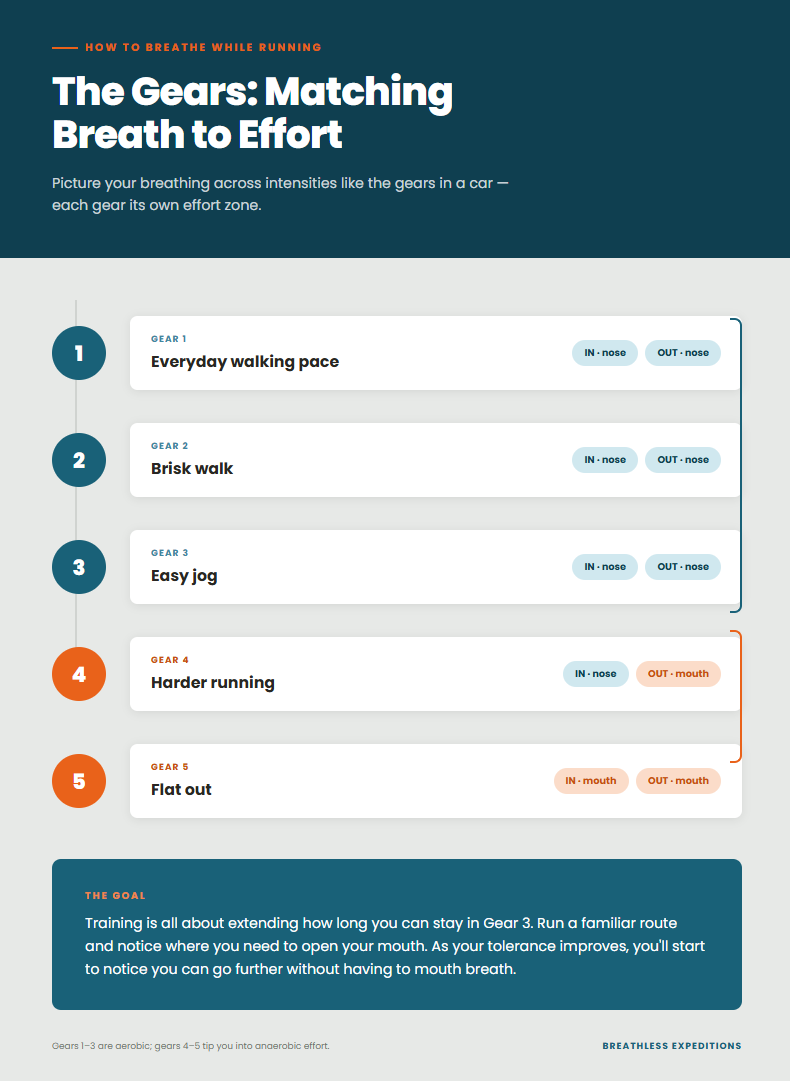
One useful way to picture breathing across intensities is like the gears of a car, with each gear, a different effort zone:
Gear 1: Everyday walking pace: nose breathing.
Gear 2: Brisk walk: nose breathing.
Gear 3: Easy jog: nose breathing.
Gear 4: Harder running: inhale through the nose, exhale through the mouth.
Gear 5: Flat out: in and out through the mouth.
Gears one to three are aerobic – in the presence of enough oxygen, the body burns fuel efficiently. Gears four and five tip you into anaerobic work, where carbon dioxide and lactic acid accumulate faster and you really start to feel it. The point of training isn’t to avoid the top gears; it’s to extend how long you can stay in Gear 3, so that more of your running happens in the sustainable range. A simple measure of progress is to run a familiar route and notice where you feel the need to open your mouth. As your tolerance increases, you should notice that you can run further inhaling and exhaling just through your nose.
Box Breathing
An easy breathwork technique to build control: inhale for four, hold for four, exhale for four, hold for four, all through the nose. It works before a run to steady the nervous system, or on rest days to train a slower baseline breathing rate.
CO2 Tolerance Drills
To build tolerance to carbon dioxide, begin with three coherent breaths – inhale for a count of five, exhale for a count of five, through the nose. On the final exhale, gently pinch the nose and hold, then test yourself:
How many steps can you walk on a single breath hold?
How far can you walk, then pick up the pace, as the urge to breathe builds?
How far can you run on one breath hold?
Treat these as markers to check against over time. Build up gradually, and never hold to the point of strain
Pre-Run and Post-Run Breathwork
Before a run, a few gentle breath holds prime the system – increasing your CO2 tolerance, helping open the airways, and sharpening your focus before your feet hit the pavement (or treadmill!). After a run, the emphasis reverses; longer, slower exhales and generally lighter breathing engage the parasympathetic nervous system and vagus nerve, lowering the heart rate and helping with your recovery.
Want To Start Your Breathwork Journey Today For Free?
This concise online program bridges the gap between ancient principles and scientific explanations. clear, simple, and immediately applicable to your life, due to 7 super effective guided exercises.
The way you breathe at rest sets the ceiling for how you’ll breathe under load. If your everyday pattern is fast, shallow, and mouth-dominant, it won’t just correct itself the moment you start running.
So the deeper work happens when you’re not running at all. Pay attention to how you breathe at your desk, on the couch, in bed, and aim for low, slow, and light – quiet nasal breaths driven by the belly, with a comfortable pause between them. That comfort is precisely what carries over to the run: more space between breaths when the pressure is on, and more to draw from when it matters.
Common Breathing Problems while Running, and How to Fix Them
1. Getting Winded Almost Immediately
This is usually a pacing issue, meaning you’ve gone out too hard and too fast. Ease back to a pace where you can easily have a conversion – then build from there. If it persists even at an easy pace, the culprit is likely shallow, rushed breathing; shift deliberately to slower belly breaths.
That sharp catch under the ribs can be linked to landing repeatedly on the same foot as you exhale. An odd-numbered rhythmic pattern (3:2 or 2:1) helps by alternating which side takes the impact, and deeper diaphragmatic breathing can help it settle even more.
3. Struggling in Cold Air
Cold, dry air is harder on the airways, which is where you really notice the difference by breathing through your nose. This is because nasal breathing warms and humidifies each breath before it reaches the lungs. On cold days, favour longer, easier runs so your breathing can keep pace with the outside conditions.
4. Falling Apart on Hills
Ascending increases the demand for oxygen. Shorten your stride, maintain your rhythm rather than chasing the same pace, and accept the shift into a higher gear – nose in, mouth out – until the ground levels off.
Breathing Tips for Beginner Runners
Start at a conversational pace: If you can’t manage a short sentence, you’re pushing too hard.
Warm up first: A brisk walk or slow jog eases your breathing rate up gradually instead of shocking it into gear.
Mind your posture: Slouching compresses the ribs and lungs; run tall, shoulders relaxed, eyes ahead.
Leave time after eating: A full stomach makes deep breathing uncomfortable.
Be patient with nasal breathing:Breathing retraining takes time, and the first few runs may feel harder or slower before your aerobic range increases.
There’s an old idea worth letting go of here – that a run only counts if it leaves you wrecked. Often the opposite is true. Breathing is the quiet variable that lets runners of any age or ability move better, feel better, and keep going for the long haul, one breath at a time.
FAQs
Should I breathe through my nose or mouth when running?
Both, at different points. Nasal breathing suits easy and moderate running because it filters the air and raises nitric oxide for better oxygen uptake. As the effort increases, add mouth breathing to take in more air when you need it.
What is the 3:2 breathing rule for running?
It means inhaling across three foot strikes and exhaling across two. The odd number shifts your exhale between your left and right foot, spreading the impact rather than loading one side, which can ease side stitches and one-sided strain.
How do I stop getting out of breath so quickly?
Most often it comes down to pace: slow to an effort where you could hold a conversation. From there, move from shallow chest breathing to deep belly breathing, which draws in more air per breath so you’re not left gasping for it. This will improve over time as you train your breathing.
Does breathwork actually improve running performance?
Yes. Practices that build carbon dioxide tolerance and train nasal, diaphragmatic breathing help you breathe less for the same effort, maintain form for longer, and recover faster. The benefit comes from consistent practice both on and off the run.
Why do I get a stitch when I run?
Side stitches are commonly tied to exhaling on the same foot strike each time, which stresses one side of the body repeatedly. An odd-numbered breathing rhythm, paired with deeper diaphragmatic breaths, usually settles it.
Medical Disclaimer:
The information in this article is intended for educational purposes only and does not constitute medical advice. Breathing exercises are generally safe for healthy adults, but individual responses can vary. If you have a pre-existing medical condition, including cardiovascular disease, epilepsy, respiratory conditions, severe anxiety or panic disorder, please consult a qualified healthcare professional before beginning any new breathing practice. If you experience dizziness, chest pain, or feel unwell during any breathing exercise, stop immediately and seek medical advice. Breathless does not diagnose, treat, or cure any medical condition.
Written by
Johannes Egberts
Johannes’s inspiring life journey is punctuated by seeking the positives in every situation, a thirst for self-discovery and a love for unconventional experiences.
Despite a challenging childhood, he discovered something unexpected that would alter the direction of his life forever – controlled breathing.
Breathwork immediately resonated with Johannes, and he relentlessly cultivated knowledge on the subject from brilliant minds such as Wim Hof, Laird Hamilton etc and acquired more than ten breathwork certifications.
His holistic wellness brand, Breathless Expeditions, has led the breathwork movement in Australia and inspired thousands of people across the globe since 2018.
With world-renowned clientele such as David Goggins, Ludovico Einaudi, A-League Sports Teams, and some of Australia’s largest companies including PwC’s The Outside event flipping professional development, team building and life reslience experiences on its head, the future is brighter than ever for Johannes and Breathless.
For additional inspiration visit his youtube channel.
How to Breathe While Running: The Best Breathwork for Runners For many runners, breathing can be an after-thought. You plan your route, your pace, your footwear, and your recovery – ...
Breathing happens around 20,000 times a day (mostly) without a single conscious thought. And for most people, that’s exactly the problem. Because when something runs on autopilot, it’s easy for ...
Ever wondered if the simple act of breathing could be a game-changer for your blood pressure? It might sound too good to be true, but science says otherwise. Infact, a ...
Breathwork has never been more popular. From corporate wellness programs to trauma-informed therapy, people are turning to the breath as a tool for stress relief, energy, emotional release and even ...
Heart rate variability (HRV) might sound like something meant for athletes or biohackers, but it’s far more universal than that. HRV is one of the simplest, most powerful indicators of ...
The practice of breathwork dates back thousands of years, and has been used across cultures to calm the mind, connect with the body, and shift emotional states. In recent years, ...
So, you’re interested in breathwork. You’ve been reading about it, or maybe even tried it yourself, and are interested in learning more about the different types of breathwork and how ...
If you’ve never practiced breathwork, you’ve probably asked yourself – is it legit? Is it scientifically proven? And, does breathork actually work?? These are important questions if you’re considering trying ...
Imagine a journey needing no suitcase or passport, just the air in your lungs. Holotropic breathwork offers such a trip! It can be a profound exploration, similar in many ways ...